|
|
Arrival of the Queen of Sheba by Handel
|
| Problems playing this file? See media help. |
The
Queen of Sheba is a
Biblical figure. The tale of her visit to
King Solomon has undergone extensive Jewish, Arabian, and Ethiopian elaborations, and has become the subject of one of the most widespread and fertile cycles of legends in the
Orient.
[1]
Narratives[edit]

The Queen of Sheba's visit to Solomon,
Tintoretto (around 1555)
The queen of Sheba (מַלְכַּת־שְׁבָא,
[2] "malkat-šəḇā" in the
Hebrew Bible, βασίλισσα Σαβὰ in the
Septuagint,
[3] Syriac ܡܠܟܬ ܫܒܐ,
[4] Ethiopic ንግሥተ፡ሳባእ፡
[5]) came to Jerusalem "with a very great retinue, with camels bearing spices, and very much gold, and precious stones" (
I Kings 10:2). "Never again came such an abundance of spices" (10:10;
II Chron. 9:1–9) as those she gave to Solomon. She came "to prove him with hard questions," which Solomon answered to her satisfaction. They exchanged gifts, after which she returned to her land.
[6][7]
The use of the term
ḥiddot or "riddles" (
I Kings 10:1), an
Aramaic loanword whose shape points to a sound shift no earlier than the sixth century B.C., indicates a late origin for the text.
[6] Since there is no mention of the fall of
Babylon in 539 B.C.,
Martin Noth has held that the
Book of Kings received a definitive redaction around 550 B.C.
[8]
Virtually all modern scholars agree that Sheba was the South Arabian
kingdom of Saba, centered around the oasis of
Marib, in present-day
Yemen. Sheba was quite known in the classical world, and its country was called
Arabia Felix.
[7] Around the middle of the first millennium B.C., there were Sabaeans also in the Horn of Africa, in the area that later became the realm of
Aksum.
[9] There are five places in the Bible where the writer distinguishes Sheba (שׁבא), i. e. the Yemenite Sabaeans, from Seba (סבא), i. e. the African Sabaeans. In
Ps. 72:10 they are mentioned together: "the kings of Sheba and Seba shall offer gifts".
[10] This spelling differentiation, however, may be purely factitious; the indigenous inscriptions make no such difference, and both Yemenite and African Sabaeans are there spelt in exactly the same way.
[9]
The alphabetic inscriptions from South Arabia furnish no evidence for women rulers, but Assyrian inscriptions repeatedly mention Arab queens in the north.
[11] Queens are well attested in Arabia, though according to Kitchen, not after 690 B.C.
[6] Furthermore, Sabaean tribes knew the title of
mqtwyt (high official).
Makada or
Makueda, the personal name of the queen in Ethiopian legend, might be interpreted as a popular rendering of the title of
mqtwyt.
[12] This title may be derived from
Ancient Egyptian m'kit (𓅖𓎡𓇌𓏏𓏛 ) "protectress, housewife".
[13]
The queen's visit could have been a
trade mission.
[7][9] Early South Arabian trade with Mesopotamia involving wood and spices transported by camels is attested in the early ninth century B.C. and may have begun as early as the tenth.
[6]
The ancient Sabaic
Awwām Temple, known in folklore as
Maḥram (the Sanctuary of) Bilqīs, was recently excavated by archaeologists, but no trace of Queen of Sheba has been discovered so far in the many inscriptions found there.
[7]
Christian[edit]
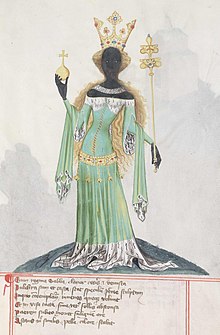
The Queen of Sheba, Prague, Czech Republic
The mystical interpretation of the
Canticles, which was felt of supplying a literal basis for the speculations of the allegorists, makes its first appearance in
Origen, who wrote a voluminous commentary on the Canticles.
[15] In his commentary, Origen identified the bride of the Canticles with the "queen of the South" of the Gospels, i. e. the Queen of Sheba, who is assumed to have been Ethiopian.
[16] Others have proposed either the marriage of Solomon with
Pharaoh's daughter, or his marriage with an Israelitish woman, the
Shulamite. The former was the favorite opinion of the mystical interpreters to the end of the 18th century; the latter has obtained since its introduction by
Good (1803).
[15]
One legend has that the Queen of Sheba brought Solomon the same gifts that the
Magi later gave to Christ.
[18]
During the Middle Ages, Christians sometimes identified the queen of Sheba with the
sibyl Sabba.
[19]
Mention should be made of the very special significance of the Old Testament for some African Christians. A number of Africans identify with the Old Testament and its rituals (such as sacrifice) and this sometimes brings them into conflict with missionaries who emphasize a Christianity based on the New Testament and European cultural taste. Africans want to embrace the Old Testament literally – such as its marriage customs and its emphasis on community – and find inspiration and sustenance in the Exodus theme of Liberation (
J. Mbiti, "African Christians and the Jewish Religion", in: Christian Attitudes on Jews and Judaism (October 1977), 1–4).
[20]
According to
Josephus (
Ant. 8:165–73), the queen of Sheba was the queen of Egypt and Ethiopia, and brought to Israel the first specimens of the
balsam, which grew in the Holy Land in the historian's time.
[7][21] Josephus (Antiquities 2.5-2.10) represents
Cambyses as conquering the capital of Aethiopia, and changing its name from Seba to
Meroe.
[22] Josephus affirms that the Queen of Sheba or Saba came from this region, and that it bore the name of Saba before it was known by that of Meroe. There seems also some affinity between the word Saba and the name or title of the kings of the Aethiopians,
Sabaco.
[23]
The Talmud (
Bava Batra 15b) insists that it was not a woman but a kingdom of Sheba (based on varying interpretations of Hebrew
mlkt) that came to Jerusalem, obviously intended to discredit existing stories about the relations between Solomon and the Queen.
[1] Baba Bathra 15b: "Whoever says
malkath Sheba (I Kings X, 1) means a woman is mistaken; ... it means the kingdom (מַלְכֻת) of Sheba".
[24]
The most elaborate account of the queen's visit to Solomon is given in the 8th century (?)
Targum Sheni to
Esther (see:
Colloquy of the Queen of Sheba). A
hoopoe informed Solomon that the kingdom of Sheba was the only kingdom on earth not subject to him and that its queen was a sun worshiper. He thereupon sent it to Kitor in the land of Sheba with a letter attached to its wing commanding its queen to come to him as a subject. She thereupon sent him all the ships of the sea loaded with precious gifts and 6,000 youths of equal size, all born at the same hour and clothed in purple garments. They carried a letter declaring that she could arrive in Jerusalem within three years although the journey normally took seven years. When the queen arrived and came to Solomon's palace, thinking that the glass floor was a pool of water, she lifted the hem of her dress, uncovering her legs. Solomon informed her of her mistake and reprimanded her for her hairy legs. She asked him three (Targ. Sheni to Esther 1:3) or, according to the
Midrash (
Prov. ii. 6;
Yalḳ. ii., § 1085,
Midrash ha-Hefez), more riddles to test his wisdom.
[1][6][7][21]
A Yemenite manuscript entitled "Midrash ha-Hefez" (published by
S. Schechter in "Folk-Lore", 1890, pp. 353 et seq.) gives nineteen riddles, most of which are found scattered through the Talmud and the Midrash, which the author of the "Midrash ha-Hefez" attributes to the Queen of Sheba.
[25] Most of these riddles are simply Bible questions, some not of a very edifying character. The two that are genuine riddles are: "Without movement while living, it moves when its head is cut off," and "Produced from the ground, man produces it, while its food is the fruit of the ground." The answer to the former is, "a tree, which, when its top is removed, can be made into a moving ship"; the answer to the latter is, "a wick."
[26]
The rabbis who denounce Solomon interpret I Kings 10:13 as meaning that Solomon had criminal intercourse with the Queen of Sheba, the offspring of which was
Nebuchadnezzar, who destroyed the Temple (comp.
Rashi ad loc.). According to others, the sin ascribed to Solomon in I Kings 11:7 et seq. is only figurative: it is not meant that Solomon fell into idolatry, but that he was guilty of failing to restrain his wives from idolatrous practises (
Shab. 56b).
[25]
In the
Kabbalah, the Queen of Sheba was considered one of the queens of the demons and is sometimes identified with
Lilith, first in the
Targum of Job (1:15), and later in the
Zohar and the subsequent literature. A Jewish and Arab myth maintains that the Queen was actually a
jinn, half human and half demon.
[27][28]
In
Ashkenazi folklore, the figure merged with the popular image of
Helen of Troy or the
Frau Venus of German mythology. Ashkenazi incantations commonly depict the Queen of Sheba as a seductive dancer. Until recent generations she was popularly pictured as a snatcher of children and a demonic witch.
[28]

Bilqis reclining in a garden, Persian miniature (ca. 1595), tinted drawing on paper

Illustration in a
Hafez Frontispiece Depicting Queen Sheba, Walters manuscript W.631, around 1539
In the
Quran, the story is essentially similar to the Bible and other Jewish sources.
[7] Solomon commanded the Queen of Sheba to come to him as a subject, whereupon she appeared before him (XXVII, 30–31, 45). Before the queen had arrived, Solomon had moved her throne to his palace with the help of a blessed scholar who was able to move the throne faster than a Jinn. She recognized the throne, which had been disguised, and finally accepted the faith of Solomon.
Publisher Note:
Queen of Sheba played a great role in the Bible with King Solomon. A movie would be nice about this Queen.
By
LAMH

 Posts


